
Agent-Writability Benchmark
Skein’s central pitch is that the language is co-optimized for humans to read and LLM agents to write (design principle P6). The agent-writability benchmark measures that instead of asserting it.
The measured trend
Section titled “The measured trend”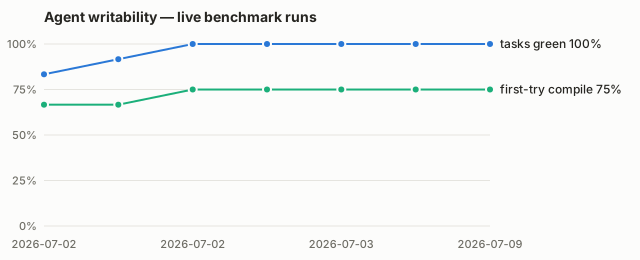
Each point is one recorded live run of the full suite. The raw data lives in
conformance/writability/history.jsonl;
the chart regenerates whenever a live run is recorded.
How it works
Section titled “How it works”For each of twelve fixed tasks spanning the language surface — pure functions,
records with Option, Result flows, enums and match, stdlib callbacks,
string interpolation, tools, HTTP handlers, the typed store, agents, LLM
effects, and scenario capability environments — the harness runs a
generate-compile-fix loop:
- Ask a code-generating model for a complete Skein module. The generation
context is the agent primer that
skein newscaffolds into every project asAGENTS.md; tasks whose surface the primer only sketches (tools, handlers, the typed store,llm.chat, scenarios) carry a short fixed crib of the relevant effect signatures, checked in with the suite. - Compile it and collect the structured diagnostics.
- Mechanically apply every machine-applicable fix (
span+edit_kind+fix_code), the way the LSP and MCP consumers do. - Feed the remaining diagnostics (JSON) back to the model and iterate to green, up to a cap.
The report carries the P6 quality metrics: first-try compile rate, mean iterations to green, how much work the machine-applicable fixes did, and which diagnostics failed to converge. A non-converging diagnostic is treated as a compiler bug — the first live run surfaced several (#336), and fixing them took the suite from 10/12 to 12/12 green.
Deterministic by default
Section titled “Deterministic by default”Every live run records the raw generations to
conformance/writability/recordings.json. CI and release-readiness run in
replay mode: the recorded generations re-run through the current
compiler with no LLM calls, so the metrics are deterministic and a recorded
solution that stops compiling is a caught regression, exactly like the
dogfood corpus.
# Replay the recordings (deterministic, no network):mix skein.bench
# Re-measure live and refresh recordings + history + chart# (needs ANTHROPIC_API_KEY):mix skein.bench -- --live
A live run can also be triggered on demand from the repository’s Writability Bench GitHub Actions workflow; the refreshed recordings land through a normal pull request, pinned by the replay test.